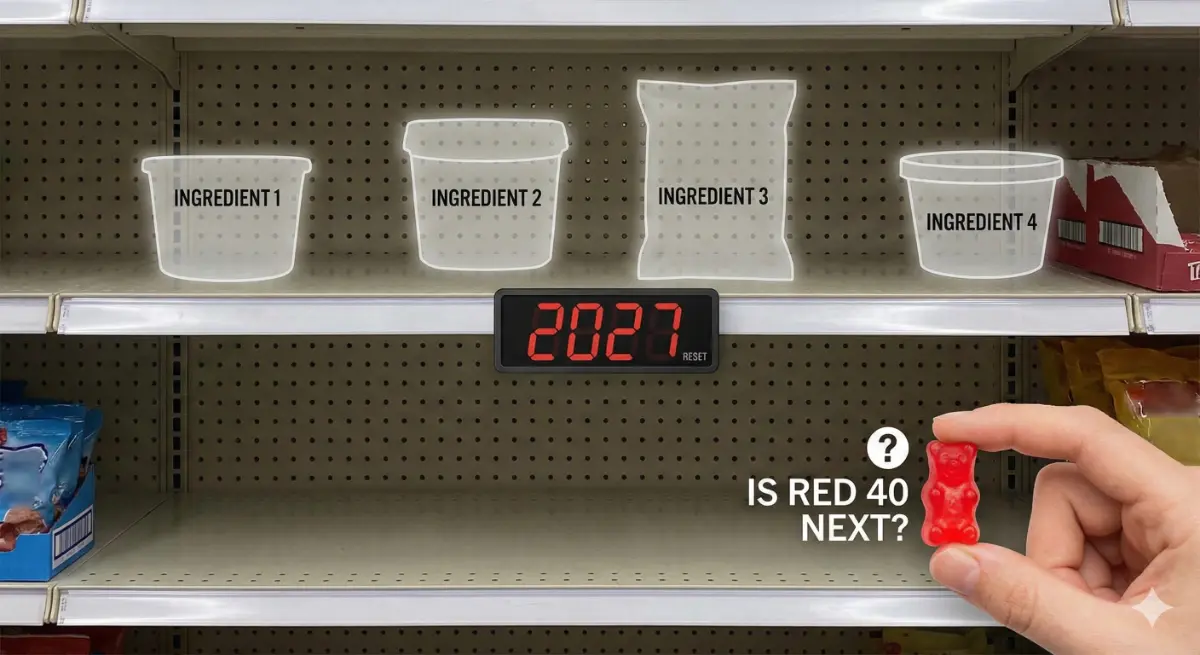
The Great Snack Reset: 4 Ingredients Vanishing by 2027 (And Is Red 40 Next?)

Reading Time: 5 Minutes
If you walked down a grocery aisle in 2024, you probably didn’t notice the invisible war happening on the shelves. But by 2027, the American snack landscape is going to look and taste very different.
While headlines were screaming about the “Skittles Ban,” a much bigger piece of legislation was signed into law: The California Food Safety Act (AB 418).
Why does a law in California matter if you live in Texas, New York, or London? Because California is so big that food companies can’t afford to make two versions of their product. This is the “California Effect.” If it’s banned there, it’s effectively banned everywhere.
Here is your guide to the “Toxic Four” ingredients disappearing by January 1, 2027, and the truth about the rumors surrounding Red 40.
1. Red Dye No. 3: The “Peeps” Problem
You might think you’ve heard of this, but don’t confuse it with Red 40 (we’ll get to that in a minute). Red Dye No. 3 (Erythrosine) is a synthetic dye derived from petroleum.
- The Ban: It has been banned in cosmetics (like lipstick) since 1990 because the FDA linked it to thyroid cancer in rats. Yet, for 30 years, we’ve been allowed to eat it.
- The Snacks at Risk: This dye is famous for creating vibrant pinks and reds in candies that don’t need fat-soluble colors. The biggest targets? Hot Tamales, pink/purple Peeps, and certain flavors of Fruit Roll-Ups.
- The Future: Expect these candies to slightly change color. Brands will switch to beetroot juice or carrot extract, which might result in a more “dusty” or pastel red rather than a neon glow.
2. Potassium Bromate: The “Cancer” in the Crust
This is arguably the most dangerous additive on the list. Potassium Bromate is an oxidizer. Bakeries use it because it strengthens dough and helps it rise higher and faster in the oven. It’s a shortcut to fluffy bread.
- The Danger: It is classified as a possible human carcinogen. It has been banned in the European Union, Canada, and Brazil for decades.
- The Snacks at Risk: It is rarely found in premium brands anymore, but it hides in generic fast-food buns, frozen pizza crusts, and bagel chips.
- 2027 Outlook: By 2027, if a pizza crust uses bromate, it cannot be sold in California. Expect a nationwide shift toward “clean label” enzymes to fluff up bread instead.

3. Brominated Vegetable Oil (BVO): The End of an Era
We mentioned BVO in our last article regarding Mountain Dew, but the 2027 ban puts the final nail in the coffin. BVO leaves residues of bromine (a chemical used in flame retardants) in body fat and the nervous system.
- The Shift: Pepsi and Coke have already largely removed it, but it still lurks in Sun Drop, generic “store brand” citrus sodas, and some obscure fruit-flavored syrups. By 2027, BVO will be extinct in the US food supply.
4. Propylparaben: The Tortilla Preservative
Parabens are usually associated with shampoo, but Propylparaben is used in food to stop mold growth. It is an endocrine disruptor, meaning it can mess with hormones and fertility.
- The Snacks at Risk: It is surprisingly common in corn tortillas (to keep them soft on the shelf) and cake decorations.
The Elephant in the Room: Is Red 40 Banned?
This is the number one question we get. “Is Red 40 illegal now?”
The Answer: No.
Despite the viral TikToks, Red Dye 40 (Allura Red) is not included in the 2027 California ban. It remains legal in the US. However, it is under intense scrutiny.
- The Controversy: Studies have linked Red 40 to hyperactivity in sensitive children.
- The EU Difference: In Europe, Red 40 is legal, but it requires a warning label stating it “may have an adverse effect on activity and attention in children.”
- The Prediction: While Red 40 survived this round of legislation, consumer pressure is mounting. We expect brands to start voluntarily removing it to avoid the “unhealthy” stigma.
How to “Future-Proof” Your Snack Drawer?
You don’t have to wait until 2027 to clean up your pantry. The market is already flooded with “Dupe” brands that mimic your favorites without the Toxic Four.
- Love Hot Tamales? Try cinnamon gummies colored with fruit juice from YumEarth.
- Craving Neon Gummies? Check out SmartSweets or Unreal Snacks. They use spirulina and turmeric for color.
The “Ingredient War” is just beginning. As California pushes for safer standards, the era of neon-glowing, chemical-laden snacks is slowly coming to an end. You can read about the American ingredients banned in Europe here.